Synopsis
Based on the datasets, what people fear most are things that remind them of the passage of time.
This content strategy was generated from a Python-based semantic SEO and clustering workflow, which analysed search and image-description data to identify recurring themes, unresolved topic clusters, and strategic artistic directions.
Most persistent fears revolve around decay, transformation, and things that evoke the passage of time:
- Crumbled grandeur, faded beauty, and ruin (fear of impermanence).
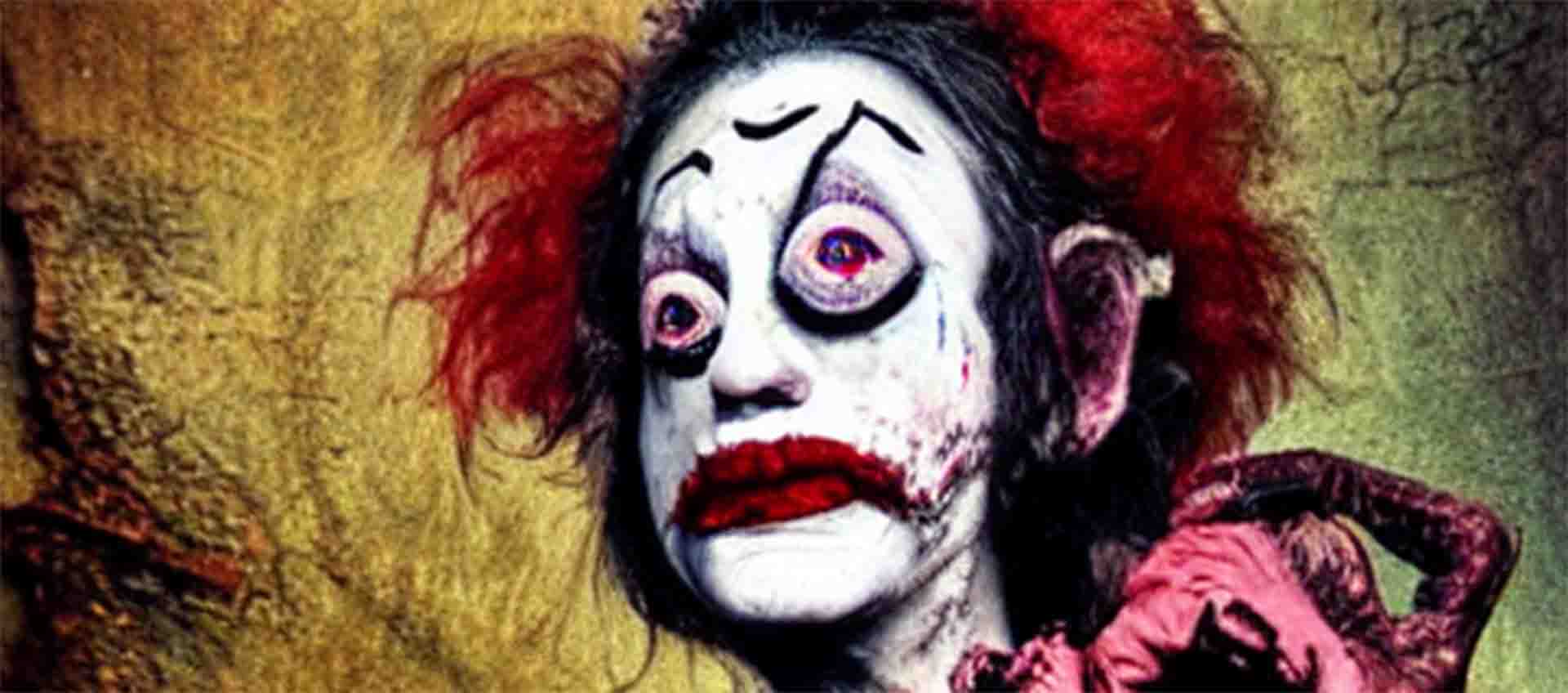
- Clowns, dolls, and puppets (familiar things distorted by time and decay).
- Masks and shifting identities (loss of self over time).
- Sacred symbols and forgotten rituals (time erasing meaning and certainty).
- Glitches, flickering images, and digital decay (technology mimicking entropy).
- Cosmic horror and existential dread (insignificance in the vastness of time).
At its core, the datasets suggest that horror is often the realisation that time is uncontrollable and inevitable�everything fades, decays, or transforms beyond recognition.
Execution Plan: How to Solidify & Market the Niche
Refine Symbolism & Ritualistic Themes
- Create recurring icons: figures that embody the corruption of faith, culture, and meaning itself.
- Blur performance and horror�your characters are actors in a cosmic tragedy, their existence itself a warning.
Lean Into Hyper-Saturated, Subversive Horror
- Maintain the candy-dystopian contrast (bright colours against horror) but evolve it into something more ceremonial, more decadent.
- Introduce themes of decay & ruinous opulence�your worlds should feel once-glorious, now diseased.
Expand the Narrative Behind the Work
- The pieces should feel like part of a cursed archive, an ongoing prophecy unfolding through images.
- Blog & Writing: Integrate short, cryptic narratives�artwork as fragments of lost myths, corrupted gospel, or forbidden rituals.
Dominate the Intersection of Pop-Surrealism, Ritual Horror, and Cosmic Decay
- The work is not just horror�it is the final performance of a world rotting from within.
- Embrace the role of the 'Unholy Harbinger'� art serves as a transmission from the inevitable collapse.
Final Positioning Statement
"I do not create horror. I document the blasphemous theatre of a dying world."
The work is not simply grotesque. It is a ritualistic act of corruption, a violent desecration of faith, theatre, and meaning itself. This is not just art. It is prophecy. It is doom.
- Seer-Clown Archetype: The conceptual depth of the "seer-clown" figure as simultaneously prophet, fool, and tragic jester is uniquely potent. It's a genuinely innovative symbolic character that offers deep thematic exploration.
- Corrupted Rituals and Occult Symbolism: The idea of integrating cryptic, corrupted rituals and occult symbols into visual artwork resonates strongly. It offers rich narrative possibilities that strongly engage audience curiosity.
- Candy-Coloured Dystopian Contrast: The deliberate contrast between bright, candy colours and grotesque horror is distinctively striking. It significantly enhances audience attention and memorability.
Defining a Niche
Based on the artwork, thematic focus, and expanded dataset, the most effective niche is a fusion of dark, surrealist, and transgressive styles. Central elements include horror, psychological distortion, and corrupted symbolism. The following genres and subgenres most precisely align with this direction:
Core Genres & Movements
These represent the foundational artistic movements reflected in the work.
1. Dark Surrealism
- Surrealist dream-logic combined with nightmarish imagery.
- Emphasises psychological unease, metaphysical dread, and visual distortion.
- Artists: Zdzisław Beksiński, H.R. Giger (biomechanical horror), David Firth.
- Why it fits? Reality is deconstructed into fragmented, uncanny, and grotesque forms, often with a hallucinatory, dream-like quality.
2. Horror Lowbrow (Pop-Surrealist Horror)
- Hyper-saturated colours contrasting with grotesque imagery.
- Often integrates pop culture references, distorted into unsettling forms.
- Why it fits? The candy-coloured dystopian horror aesthetic, corrupted clown iconography, and twisted theatricality align directly with this genre.
3. Symbolic Religious Horror (Blasphemous Gothic Surrealism)
- Themes of corrupted faith, lost rituals, and unholy transformation.
- Gothic aesthetics with an emphasis on mysticism, desecration, and divine mockery.
- Why it fits? Biblical corruption, ritualistic horror, and existential dread intersect with gothic surrealism and esoteric horror.
4. Theatre of the Grotesque (Vaudeville Macabre, Twisted Performance Horror)
- Clown aesthetics, carnival horror, and the grotesque as performance.
- Over-exaggerated expressions, mutilated humour, and the eerie uncanniness of forced joy.
- Why it fits? Disturbing theatrical imagery-corrupted circus motifs, unsettling clowns, and menacing performances—directly aligns with grotesque theatre horror.
Specialised Niche Directions
For full entrenchment into a specialised sub-niche, the following represent the most strategic choices based on theme alignment, SEO potential, and stylistic distinctiveness:
1. Corrupted Folklore Horror (Folk Horror Surrealism)
- Cultural myths and fairytales twisted into grotesque nightmares.
- Often features ancient rituals gone wrong, forgotten gods, and perversions of tradition.
- Key SEO Keywords: "Twisted Cultural Symbolism," "Corrupted Folklore," "Haunting Folk Horror."
- Why it fits? Baroque influences, themes of forgotten gods, desecration, and distorted cultural symbols align with this direction.
2. Candy-Coloured Dystopian Horror (Unholy Carnival Aesthetics)
- Bright, playful colours juxtaposed with grotesque imagery.
- Warped nostalgia, sinister entities, and exaggerated smiles turned menacing.
- Key SEO Keywords: "Candy Horror Dystopia," "Unholy Carnival Aesthetics," "Distorted Rainbows."
- Why it fits? High-saturation visuals, grotesque theatricality, and chaotic energy are central traits within this niche.
3. Symbolic Religious Horror (Ritualistic Dread and Desecration)
- Sacrilegious themes, corrupted holy imagery, and metaphysical horror.
- Merges gothic, surrealist, and existential horror into divine mockery.
- Key SEO Keywords: "Gothic Horror with Surrealist Overtones," "Psychological Horror Art," "Nightmare Surrealism."
- Why it fits? Thematic focus on blasphemy, corrupted reverence, and existential despair defines this category.
4. Psychosexual Body Horror (Filth and Flesh Deconstruction)
- Decay, grotesque transformation, and bodily corruption.
- Organic-mechanical hybrids, flesh merged with machinery, and raw, unsettling forms.
- Key SEO Keywords: "Psychosexual Horror Art," "Grotesque Erotic Horror," "Uncanny Body Distortion."
- Why it fits? Fragmented facial imagery, combined with themes of corruption and distortion, aligns closely.
Strategic Considerations
- For SEO-optimised and visually distinctive output → Corrupted Folklore Horror or Candy-Coloured Dystopian Horror
- For conceptually rich and emotionally disturbing direction → Symbolic Religious Horror or Psychosexual Body Horror
- For maximal theatrical impact → Theatre of the Grotesque and Vaudeville Macabre
Recommended fusion niche:
"Blasphemous Pop-Surrealist Horror with Theatrical Grotesque Aesthetics."
This formulation integrates dark surrealism, twisted folklore, and corrupted performance horror into a distinct, unified identity.
Core Artistic Themes to Pursue (Based on Dataset)
Clown as Seer & Truth-Teller
- The fool who speaks hidden truths
- Grotesque laughter masking wisdom
- Duality of joy and menace
Decay & Grand Ruin
- Faded opulence, forgotten grandeur
- Ornate, crumbling beauty—baroque ruin
- Time’s erosion of sacred and profane
Masks & Shifting Identity
- The hidden self vs. the performed self
- Masks as protection, deception, and revelation
- Fragmented, shifting personas in motion
Sacred Symbols & Glyphs
- Occult scripts and forbidden knowledge
- Ritualistic markings, distorted prophecy
- Sigil-like language within surreal environments
Flickering & Digital Decay
- Reality breaking apart—glitches, distortion
- Faces flickering between states of being
- Decomposition revealing deeper layers
Cosmic Horror & Psychological Collapse
- The infinite unknown, existential dread
- Madness encoded in symbols and faces
- Unstable perspectives—characters dissolving
Puppetry & Animated Ritual
- Marionettes, broken automata, living dolls
- Stop-motion unease, jerky unnatural movement
- Ritualistic animation loops—endless cycles
Theatre of the Uncanny
- Ballet, masquerade, gothic opera
- Performance as revelation and deception
- Elegance twisted into horror
Each theme reinforces transformation, deception, and the slow collapse of meaning, making them ideal for animation, masks, 3D sculpture, and experimental video production.
The Truth-Teller Perceived as a Fool
(The Seer-Clown as an Unheeded Prophet, a Mockery of Revelation, and a Cosmic Jester)
A truth-teller perceived as a fool is a figure of contradiction—someone who speaks reality plainly, yet is ignored, mocked, or misunderstood. This is where the seer and the clown fully merge:
- The seer knows the truth, but cannot make others believe it.
- The clown distorts reality, yet paradoxically reveals hidden truths.
- Together, they form a character who sees all but is never taken seriously—whose warnings are dismissed as comedy, whose gestures conceal revelation.
This archetype operates at the intersection of horror, theatre, and surrealism—a figure who laughs while the world burns, not because they are cruel, but because no one will listen.
1. The Seer-Clown as the Rejected Oracle
(Prophecy Rendered Useless by the Absurdity of the World)
- If the seer is cursed to know the truth, the clown is cursed to be ignored.
- This character delivers warnings that are mistaken for jokes, or jokes that, in hindsight, were warnings all along.
- It represents the horror of foresight with no power to change events.
Visual Execution:
- A clown delivering a prophecy, but the words dissolve into nonsense mid-sentence.
- A painted performer gesturing toward doom, but the audience only claps and laughs.
- A seer in a fool’s motley, holding a sign with an urgent warning—written in a dead language, unreadable to all.
2. The Jester as the Only One Who Knows the Truth
(A Fool in Appearance, a Prophet in Reality)
Throughout history, jesters and clowns have been the only ones allowed to speak truth to power, yet their words were treated as mere entertainment.
- What happens when the fool is actually the wisest figure in the room?
- What happens when the painted smile hides unbearable knowledge?
- What if the "comedy" is the only way to deliver truth, because reality is too horrific to be spoken plainly?
Unification with the Clown:
- The Seer-Clown wears a mask of mirth, but beneath it is exhaustion, madness, or sorrow.
- It knows the joke is real, but the audience doesn't.
- Its performance is not for entertainment, but an attempt—however futile—to reveal something deeper.
Visual Execution:
- A clown on a burning stage, delivering a routine as the theatre collapses around them.
- A jester with empty eye sockets, who "sees everything" despite being blind.
- A marionette figure who knows it is controlled, but continues to perform, whispering to the audience that the strings are real.
3. The Cosmic Jester: The Horror of Truth in a Nonsensical Universe
(When Reality is Too Absurd to be Anything but a Joke)
This iteration of the Seer-Clown aligns with cosmic horror:
- The truth is unbearable.
- The only reaction is laughter.
- Madness and comedy become the same thing.
The Seer-Clown sees beyond the veil and realises everything is a performance, a scripted joke written by forces beyond human comprehension.
Unification with the Clown:
- The smile isn’t a mask—it’s a defence mechanism.
- The laughter is not joy—it is hysteria, the only sane response to an insane world.
- The Seer-Clown understands the cosmic punchline, but no one else does.
Visual Execution:
- A clown performing in an empty void, delivering a monologue to an audience that does not exist.
- A painted figure laughing while its flesh peels away, revealing something unknowable beneath.
- A seer who understands everything, yet is only capable of speaking in riddles and nonsense rhymes.
4. The Ritual Clown: A Fool Who is a Gatekeeper of Forbidden Knowledge
(Absurdity as a Key to the Arcane, Chaos as a Sacred Language)
- In some traditions, fools and tricksters hold hidden wisdom, concealed behind layers of deception.
- The Seer-Clown could be a gatekeeper to esoteric knowledge, but only those who understand the "joke" can comprehend it.
- This aligns with ritualistic scripts, sigil-based typography, and hidden symbolism in performance.
Unification with the Clown:
- The Seer-Clown performs nonsensical rituals, yet these rituals hold real meaning.
- To outsiders, it seems absurd, ridiculous, even childish—but beneath the playfulness is something real, something ancient.
- The clown is both a key and a distraction—drawing attention away from the truth while leading people toward it.
Visual Execution:
- A clown drawing sigils in the air, their gestures exaggerated and ridiculous, yet unnervingly precise.
- A seer in a harlequin mask, whispering riddles that are actually invocations.
- A circus act that, when seen in full, forms a complex ritual pattern in the movement of the performers.
5. The Horror of the Laughing Prophet: When No One Believes the Truth
(The Fool Who Knows Everything and Can Change Nothing)
- The ultimate horror of the truth-teller perceived as a fool is that it doesn’t matter if they are right—no one will listen.
- They are trapped in a performance that is mistaken for entertainment, delivering dire warnings that are never taken seriously.
- They laugh because the alternative is to scream.
Unification with the Clown:
- The clown is doomed to repeat the same performance, night after night, cycle after cycle.
- It is an actor in a script it cannot change.
- It knows how the story ends—but its warnings only earn applause, never action.
Visual Execution:
- A painted mime, stuck in a loop, endlessly reenacting an ancient tragedy.
- A joker in the gallows, smiling as they deliver their last words—words no one will remember.
- A fortune teller whose readings are always right, but are never heeded.
Summary: The Seer-Clown as the Ultimate Warning
This character is not just a fool or a prophet—it is a mirror, reflecting a world that refuses to listen, a universe that plays out the same tragedies over and over.
Core Themes:
- Prophecy Dismissed as Comedy – The truth-teller is ignored because they are too theatrical, too absurd, too unbelievable.
- Tragic Irony – The warnings are mistaken for entertainment, and by the time they are understood, it is too late.
- The Unbearable Punchline – The clown laughs because truth is too horrific to be spoken plainly.
- Reality as Theatre – The universe is a scripted performance, and the Seer-Clown knows the ending but cannot rewrite it.
- Chaos as Revelation – Absurdity and nonsense conceal deeper meaning, but only those willing to decode the joke will understand.
Final Thought:
The Seer-Clown is a living paradox—the only one who understands reality, yet doomed to be dismissed by it. It laughs, not because it is happy, but because the truth, when spoken aloud, always sounds like madness.
The Role of the Clown: Transformation, Theatrical Horror, and Duality
The clown functions as a thematic core, embodying transformation, distortion, and theatrical grotesquerie. It unifies key motifs—decay, masks, ritual, and horror in the passage of time—into a single visual and symbolic structure.
1. The Clown as a Mask of Duality (Between Laughter and Horror, Joy and Terror)
- An unnatural exaggeration of the human face, ideal for distortion, ambiguity, and psychological unease.
- Represents contradiction—simultaneously inviting and repelling, familiar yet alien, oscillating between entertainer and nightmare.
- Reflects instability of identity, aligning with decay and transformation as perpetual states.
2. The Clown as an Expression of Theatrical Grotesquerie (Performance, Exaggeration, and Ritual)
- Theatrical grotesquerie is defined by excess and distortion—qualities embodied by the clown.
- Clown makeup, as exaggerated emotion, becomes monstrous when decayed or malformed.
- Connects directly to ritual, masquerade, and transformation through masks, sigils, and esoteric performance.
Practical Execution:
- Clown imagery with smeared, cracked, or faded paint.
- Theatrical lighting that renders the figure both present and ephemeral.
- Carnival and masquerade aesthetics infused with horror.
3. The Clown as an Agent of Time and Decay (Aged Performance, Forgotten Spectacles)
- Clowns symbolise the remnants of obsolete entertainment.
- As decayed figures, they embody forgotten joy and abandoned spectacle.
- Reinforces horror through the passage of time—what was once vibrant now crumbles into grotesquerie.
Practical Execution:
- Peeling circus posters revealing grotesque imagery beneath.
- Performers appearing trapped in their act long after the audience has vanished.
- Flickering visuals shifting between mirth and terror, fragmented by time.
4. The Clown as a Liminal Entity (Neither Human nor Monster, Always Between States)
- Occupies a transitional state—between mask and face, humour and fear, performer and enigma.
- Embodies themes of transformation, concealment, and unstable identity.
- Serves as a metaphor for memory distortion and the impermanence of self.
Practical Execution:
- Clowns with shifting or compound expressions.
- Fragmented portraits emphasising psychological fracture.
- Ritualistic designs combining tribal, sigilic, and theatrical elements.
5. The Clown as a Vessel for Horror in the Passage of Time
(Eternal Performance, Inescapable Identity)
- Exists solely as performance, unable to escape role or repetition.
- Becomes a symbol of existential horror—trapped in a decaying act while the world progresses.
- Intersects with themes of psychological entrapment, theatrical dread, and temporal decay.
Practical Execution:
- Endless animation loops of decaying clowns.
- Misaligned makeup and facial features to imply fractured identity.
- Carnival remnants entwined with opulent decay.
Summary: The Clown as a Central Motif
The clown functions as a unifying symbol across decay, horror, transformation, and theatricality. It embodies:
- Duality – A constant tension between joy and terror.
- Theatrical Grotesquerie – A monstrous, exaggerated performance.
- Decay and Time – A relic of fading spectacle.
- Liminal Identity – A presence always caught between states.
- Existential Horror – A performance without escape, endlessly deteriorating.
This makes the clown an ideal subject for visual exploration through airbrush, animation, distortion, and layered techniques—mediums well-suited to its unstable and shifting form.
The Role of the Seer and Its Unification with the Clown
The seer and the clown represent opposing forces—prophecy versus chaos, insight versus deception. When unified, they form a paradox: a truth-teller mistaken for a fool, a performer revealing hidden knowledge through absurdity, an oracle whose language is riddles and laughter.
1. The Seer as a Guide Through Decay and Time
(Prophecy, Ruin, and the Inescapability of Fate)
The seer observes beyond the present—into decay, entropy, and inevitability.
- Aligns with fallen grandeur, forgotten spectacles, and decaying performance traditions.
- Reflects transformation and distortion, where truth becomes warped over time.
- Embodies the horror of foreknowledge without agency.
Unification with the Clown:
- The clown is bound to endless repetition, caught in a loop of performance.
- When aware of its own inevitable decay, this figure mocks instead of warns.
- Prophecy becomes irony, revelation becomes twisted humour.
Visual Execution:
- A clown marked with sigils, eyes painted over like a blind oracle.
- A flickering image alternating between painted glee and grim foresight.
- A dilapidated carnival tent housing a masked fortune teller whose truths go unheard.
2. The Seer as a Trickster of Hidden Knowledge
(The Mask of Comedy Hiding the Face of Horror)
Deception and revelation merge—truth is obscured to be seen.
- Reflects use of ritual masks, distorted faces, and cryptic meaning.
- The clown presents falsehoods that encode deeper truths, mirroring the indirectness of prophecy.
Unification with the Clown:
- Truth emerges through grotesque pantomime, surreal gestures, and disturbing riddles.
- Functions as a fate-bound puppet within an inescapable tragic farce.
- Knowledge is expressed mockingly, laughed at in despair.
Visual Execution:
- A cracked porcelain mask reveals a burning eye beneath.
- A fortune teller’s crystal ball showing memories rotted by time.
- A stitched-smile mouth delivering prophecy in laughter.
3. The Seer-Clown as an Agent of Ritual and Transformation
(Prophetic Laughter, Ritualistic Chaos, and the Unmasking of Reality)
Absurdity becomes ceremony. Meaning is fragmented, obscured, reconfigured.
- Clown performance becomes ritual, invoking unseen forces.
- Challenges the sanctity of divine insight—what if enlightenment is cruel nonsense?
- Aligns with sigilic language, occult scripts, and esoteric distortion.
Unification with the Clown:
- The circus transforms into sacred theatre.
- The Seer-Clown operates as a conduit for incomprehensible knowledge.
- Prophecy functions as a chaotic spectacle, implicating all who observe.
Visual Execution:
- A clown marked with esoteric glyphs performing an invisible rite.
- A face oscillating between elation, terror, and madness.
- A tent filled with masks inscribed with forgotten invocations.
4. The Seer-Clown as an Avatar of Cosmic Horror
(The Laughing Prophet of an Unknowable Universe)
Overexposure to truth fractures the seer. The clown remains.
- Reflects the collapse of understanding under existential weight.
- Truth is unbearable, absurd, and untranslatable.
- Delivers horror through nonsense, slapstick, and grotesque mimicry.
Unification with the Clown:
- Reality’s collapse is expressed as performance.
- Laughter becomes resignation, a gesture of futility.
- Simultaneously puppet and puppeteer, warning and parody.
Visual Execution:
- A spiralling third eye that opens only during laughter.
- A mouth whose words lag behind movement, garbled and broken.
- A mirror maze that warps all reflections into distorted falsehoods.
Summary: The Seer-Clown as a Core Archetype
This archetype synthesises key thematic structures:
- Decay and Transformation – A performer aware of its inevitable deterioration.
- Theatrical Grotesquerie – A prophet delivering absurd, exaggerated warnings.
- Ritual and Esotericism – A masked entity enacting prophecy through chaotic form.
- Cosmic Horror and Psychological Collapse – A being broken by knowledge, sustained by madness.
- Temporal Horror – A figure bound to eternal repetition, cycling through the same doomed performance.
The union of clown and seer creates a potent narrative engine—one that reveals through distortion, warns through mockery, and horrifies through spectacle.
Custom Video Production Approach: Maximising Artistic Identity
An artistic identity built on structured chaos, horror surrealism, decay, neon aesthetics, and unsettling contrast requires a bespoke video production approach. A hybrid workflow that merges tactile and digital elements—particularly airbrushing, stop-motion, mixed media, After Effects, and Houdini—offers the most coherent path forward.
1. Core Video Style: “Digital Decay & The Occult Glitch”
This visual identity thrives on distortion, texture, and contrast. Video execution should amplify these through:
- Textural erosion and decay (practical and digital)
- Glitch horror and corrupted movement
- Uncanny humanoid figures and unnatural animation
- Neon-washed grime—aesthetic tension between vibrancy and rot
- Surreal, physics-defying compositions
A structured workflow should incorporate procedural digital effects, airbrushed textures, and precision motion design.
2. Primary Workflow: Hybrid Practical–Digital
Step 1: Tactile Elements and Raw Materials
Airbrushed and physical texture work can be directly integrated via:
- Stop-motion elements: Masked figures, painted textures, or physical models
- Hand-painted distortions: Ghostly overlays created with physical media
- Scanned decay: Cracked, splattered, or corrupted textures scanned for digital use
- Physical glitching: Damaged printouts re-scanned to simulate analogue degradation
Purpose: Grounds digital work in tangible matter, enhancing psychological weight.
Step 2: Procedural Digital Enhancements
Captured material can be imported into After Effects and Houdini for surreal extension and refinement.
After Effects (Motion Control, Post-Processing, Compositing)
- Controlled glitch effects via displacement and databending
- Typographic distortion for psychological impact
- Time warping through frame blending and artefact layering
- Neon and shadow contrast: high-saturation overlays on deep blacks
- Texture overlays: Integrating paint and decay into motion
Purpose: Maintains tactile presence while deepening thematic structure.
Houdini (Procedural Horror, Decay, Unnatural Motion)
- Decay simulations using particles and erosion shaders
- Procedural growth of veins, tendrils, and glitch-organic structures
- Gravity-defying motion for dreamlike horror sequences
- Volumetric fog and distortion for inhuman ambience
- Soft-body deformation for digital body horror
Purpose: Enables unnatural, surreal motion with deep structural control.
3. Experimental Aesthetic Techniques
Corrupting Reality
- Datamoshing for broken, haunted movement
- AI-driven animation using models trained on distorted artwork
Hybrid Stop-Motion & Digital Augmentation
- Static paintings animated digitally with shifting elements
- Frame-rate blending between real and procedural motion
Uncanny Human Movement
- Frame interpolation artefacts for ghost-trailing effects
- Facial feature warping via displacement and mesh distortion
4. Resonant Content Types
Formats that maximise impact and audience engagement:
- Short-form experimental videos (10–60 sec) for social media
- Seamless looping animations for Instagram and TikTok
- Horror-themed music videos or visuals for underground artists
- Longer atmospheric sequences with progressive degradation
5. Conclusion
Effective execution requires:
- Physical textures and airbrush work for grounding
- Motion typography and glitch layering via After Effects
- Procedural decay and transformation via Houdini
- Experimental workflows blending AI, frame interpolation, and databending
This approach leverages both analogue and digital media to form a distinct and unsettling visual identity—merging decayed beauty, structured distortion, and surreal horror into a singular form.